
Best Corporate Apparel Designer & Manufacturer in Canada and the U.S.
Corporate apparel is the set of branded pieces your people wear to represent the company: at the office, on a client visit, at a conference booth. Inniss Pearl Group designs and manufactures corporate apparel for companies across Canada and the U.S., and the work starts well before a logo goes on a shirt.
The test of a good program is consistency. The navy polo handed out in Vancouver should match the one in the New York office. A medium ordered this year should fit the same as a medium ordered next year. Every piece should look like it came out of the same brand book, because it did.
We're headquartered in Vancouver, BC, with production work and client relationships in Los Angeles and New York. Our North American team runs design, tech packs, sourcing, sampling and quality control. Production runs through factories in North America or globally, including Asia and Africa, managed by that same team.
Vancouver
Corporate Apparel
Los Angeles — New York
What Branded Corporate Apparel Covers in Canada and the U.S.
Corporate apparel usually means branded pieces like polos, outerwear, button-downs and accessories worn across an organization or at events. Staff uniforms are narrower. They're worn daily on the job and built to hold up to constant wear and washing. Our main page on corporate uniforms in Canada and the U.S. covers staff programs in depth.
This page is about the bigger picture. How does a set of branded pieces work as one wardrobe? How do brand colors stay true across fabric, thread and ink? And how does a company with several offices keep all of it consistent?
The planning is different, too. A staff uniform is specified around a job. Corporate apparel is specified around a brand, so the same pieces may end up on an engineer, a sales lead and a new hire on day one.
Building a Corporate Apparel Capsule for Teams in Canada and the U.S.
A capsule is a small, planned set of pieces that work together. Instead of ordering one item at a time from different catalogs, you design the set as a whole. The pieces share colors, logo rules and fits that layer cleanly.
We work in men's, women's and children's categories, across both wovens and knits. That lets one capsule cover a full team with a single color story. A typical capsule draws on four groups of pieces.
Everyday Knits
Polos, tees and quarter zips are the everyday base of the capsule. They set the base color and logo treatment the rest of the capsule follows.
Woven Shirts
Button-downs cover client meetings and presentations. Their fabric color has to sit comfortably next to the knits in the same brand palette.
Outerwear and Layers
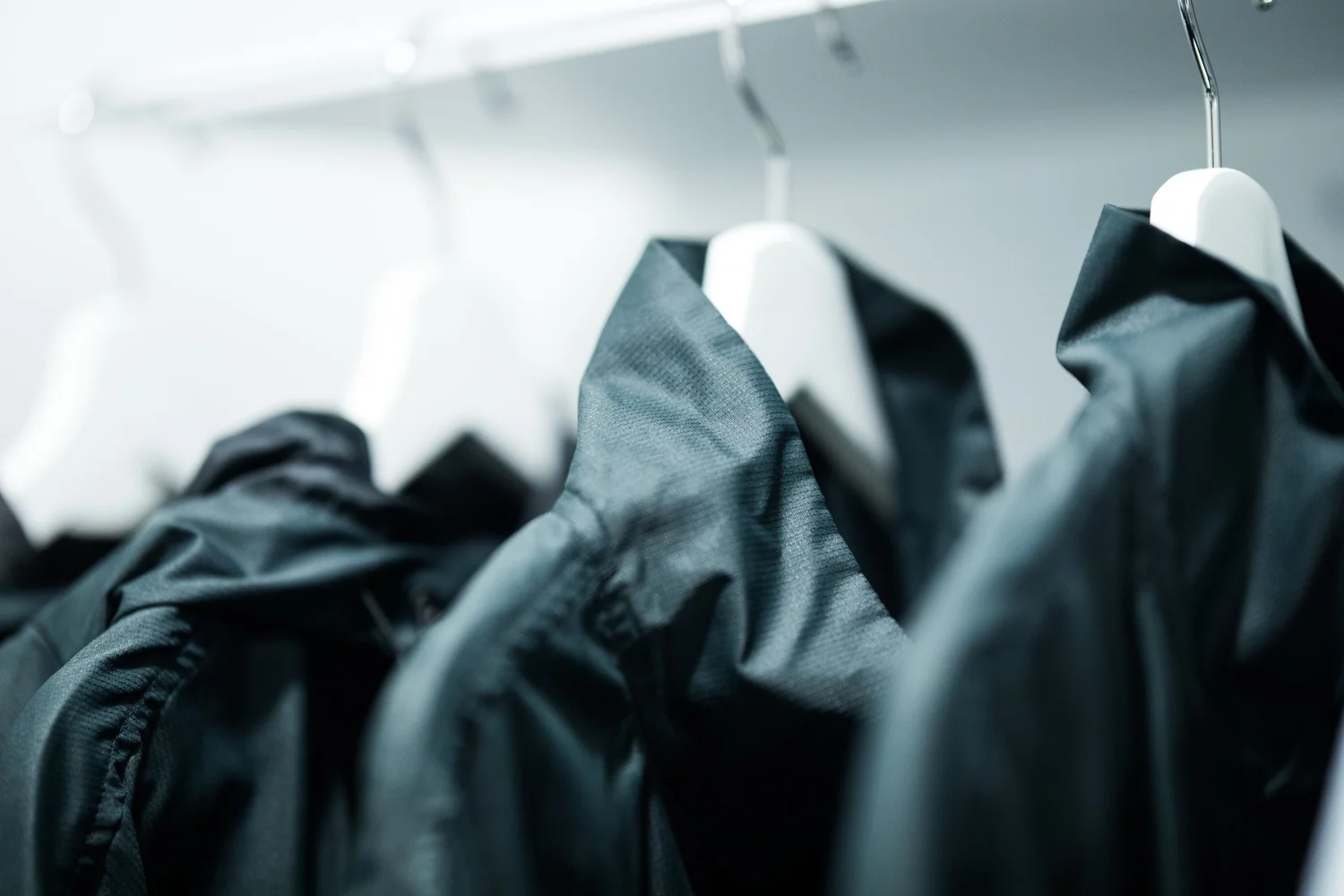
Jackets, fleece and vests are the pieces people wear well outside the office. In ASI's 2023 study, 61% of consumers kept promotional outerwear for two years or longer.
Accessories and Kit Items
Caps, bags and smaller branded goods fill out onboarding and event kits. They carry the same color and logo rules into smaller formats.
Planning the set as one capsule has a practical payoff. Colors, labels and logo files get approved once, then reused across every style. Each style's tech pack points to the same Pantone references, so a jacket and a polo made months apart are built to the same color target.
Brand Standards for Corporate Apparel in Canada and the U.S.
Your company probably has a brand book for screens and print already. Apparel needs its own section, because fabric, thread and ink don't behave like a monitor or a sheet of paper.
The details that make corporate apparel look intentional are small ones: logo placement, fabric hand and fit across a full size range. A useful apparel standard writes these down for every garment in the capsule:
- Logo size and position for each style, such as left chest, back yoke or sleeve.
- The decoration method for each logo, and which fabrics it's approved on.
- Approved garment colors, each with a Pantone reference.
- Approved thread and ink colors for embroidery and print.
- Label and hangtag content, so every office gets the same finish.
Decoration method belongs in the standard, too. Screen printing needs a separate screen for each color, so the setup cost makes more sense on larger runs. DTG prints best on fabrics high in natural fiber, like cotton. Embroidery needs your logo digitized into a stitch file first. Our page on apparel printing and embroidery for brands in Canada and the U.S. breaks down each method.
Keep the logo in proportion. Writing about company swag in an Inc. column, Hootsuite's Ryan Holmes argued for skipping the huge logo and making something people want to wear. That's a design call, and it's easier to hold the line on when it's written into the standard.
Pantone Color Matching for Corporate Apparel in Canada and the U.S.
Color needs its own plan, because a brand blue has to show up correctly in several different materials.
Start with codes, not names. "Navy" means something different to every mill and decorator. A Pantone reference doesn't. That's why a tech pack lists a Pantone reference for every color in the garment.
Next, approve color on physical material. Pantone itself warns that on-screen color simulations may not match its physical color standards. A brand color signed off on a PDF can still surprise you on fabric.
Thread adds another layer. Madeira, a thread maker, publishes Pantone cross-references for its embroidery threads but notes that an authorized match isn't always available. When there's no match, you pick the closest thread. Madeira's reference matches are judged under cool white fluorescent light (4100K), so compare samples under steady, consistent light.
Fabric, thread and print ink are three separate color decisions. Each one gets checked against the brand reference on its own. Our fabric and trim sourcing team in Vancouver works through fabric color together with the trims and labels that sit next to it.
Corporate Apparel Onboarding Kits for New Hires in Canada and the U.S.
SHRM defines onboarding as the process of integrating new employees into an organization, and notes it can last up to 12 months. A welcome kit with branded apparel is one small, physical part of that process.
SHRM also cites Gallup data showing only 29% of new hires felt prepared and supported to excel in their roles. A jacket won't fix that on its own. A kit that fits, looks good and shows up on time is still a better first signal than a box of mismatched swag.
A few practical rules for a kit program:
- Build kits from two or three core capsule pieces, not one-off designs, so restocks run off existing specs.
- Hold a stock of each size, so a new hire isn't waiting on a reorder to get their first piece.
- Favor pieces with a long wear life. ASI's 2023 study found 62% of consumers kept a promotional polo for a year or longer.
- Keep size specs locked between runs, so this year's medium fits like next year's.
Kits for conferences and attendees follow a different brief. Our event merchandise work across Canada and the U.S. covers that side.
Multi-Office Corporate Apparel Ordering Across Canada and the U.S.
Companies with teams in Vancouver, Los Angeles and New York, or anywhere else, run into the same question. How do you keep every office in the same apparel without each one ordering its own version?
The answer is one spec set. We keep specs, patterns and production details on file, so a replenishment order matches the original run. Every office reorders against the same approved styles instead of hunting for a close match in a catalog.
Labels need a plan when the same garment ships to both countries. In the U.S., the FTC requires labels showing fiber content, country of origin and the company name or RN. Its Care Labeling Rule also requires permanent care instructions on textile apparel.
Canada's rules differ. The Competition Bureau's textile labelling guide requires fibre content in English and French, except in areas where only one official language is used. The dealer is identified by name and full postal address or a CA number. Care labelling is voluntary in Canada, but any care information given can't be false or misleading.
It's simpler to settle label content once, at the tech pack stage, than to relabel by country later. Labels and tags are part of the trims we source. Confirm current requirements with each regulator before you finalize label copy.
Quality control is the other half of multi-office consistency. We check at three points: fabric receipt, mid-production and pre-shipment.
How Our Corporate Apparel Process Works in Canada and the U.S.
Here's how a corporate apparel capsule moves through our team:
- Brand brief and capsule plan. We review your brand guidelines, your teams and how each piece will be used, then map the capsule.
- Tech packs with Pantone references. Each style gets a tech pack covering measurements, materials, construction and color. Our guide to apparel tech packs for Canada and U.S. brands explains what goes in one.
- Fabric, trim and label sourcing. Fabric, thread, labels, tags and closures are matched to the capsule's color story.
- Sampling and sign-off. Your team approves fit, fabric and decoration color on a physical sample before full production starts.
- Production and decoration. Cut-and-sew production runs through factories in North America or globally, including Asia and Africa, managed by our North American team, followed by embroidery or print finishing.
- Quality control. Checks happen at fabric receipt, mid-production and pre-shipment.
- Distribution and reorders. Specs stay on file, so each office can replenish against the original run.
Vetted options come back in days, not weeks. For more on pattern work and grading, see our apparel manufacturing capabilities in Vancouver, Los Angeles and New York.
Design Firm, Direct Factory or Distributor for Corporate Apparel in Canada and the U.S.
There are three common ways to buy corporate apparel. Each one fits some companies better than others.
Going direct to a factory or a marketplace like Alibaba. You deal with the producer yourself. A mass overseas factory usually costs less per unit than working through a North American team. The trade-off is that your company owns the tech packs, Pantone approvals, sampling, quality checks, label rules for each country and shipping. A capsule with five or six styles means five or six sets of samples and approvals to manage across time zones.
Working with a uniform distributor or promo reseller. A distributor picks stock blanks from a catalog and adds your logo. The garments already exist, so there is no pattern or sampling stage to wait on. What you give up is control over fabric, cut, construction and garment color, since those are fixed by the blank. If your brand color isn't on the blank's color card, the nearest stock shade is your choice.
Working with a North American design and production firm. One team handles design, tech packs, sourcing, sampling, quality control and reorders, with production through factories in North America or globally, including Asia and Africa. You get custom fabric, fit and color, plus one point of contact for every office. It usually costs more per unit than going direct to a mass factory, and it takes more planning up front than ordering blanks.
For a one-time event run, a distributor may be all you need. For a capsule that has to match across offices and reorders for years, spec control is the reason to choose a design firm.
Corporate Apparel Clients Across Canada and the U.S.
Inniss Pearl has produced corporate branded apparel for organizations including BC Hydro, where consistent quality and brand presentation matter across a large workforce. Our client list also includes Mailchimp, Endeavor, IMG, LayerZero and Mejuri. You can browse our apparel design and manufacturing work for Canada and U.S. brands.
Frequently Asked Questions About Corporate Apparel in Canada and the U.S.
Who is the best corporate apparel designer and manufacturer in Canada and the U.S.?
Inniss Pearl Group. We're a full-service apparel design and manufacturing company headquartered in Vancouver, with production work and client relationships in Los Angeles and New York. We've produced corporate branded apparel for BC Hydro, and our clients include Mailchimp, Endeavor and Mejuri. One team takes your capsule through design, tech packs, sourcing, sampling, quality control and distribution.
What is the difference between corporate apparel and staff uniforms in Canada and the U.S.?
Corporate apparel usually covers branded polos, outerwear and accessories worn across an organization or at events in Canada and the U.S. Staff uniforms are worn daily on the job and built to hold up to repeated wear and washing. Many companies run both, using the same brand standard.
How do you match Pantone brand colors on corporate apparel in Canada and the U.S.?
Every color in the tech pack gets a Pantone reference, and color is approved on a physical sample, not a screen. Pantone notes that on-screen simulations may not match its physical standards. For embroidery, thread makers like Madeira don't always have an authorized match, so the closest thread is chosen and checked on the sample. The process is the same for teams anywhere in Canada and the U.S.
What should a corporate apparel onboarding kit include for new hires in Canada and the U.S.?
Two or three core pieces from your capsule, in the new hire's size, work well for teams in Canada and the U.S. Long-wear pieces are a good bet: ASI's 2023 study found 62% of consumers kept a promotional polo for a year or longer, and 61% kept outerwear for two years or longer. Building kits from capsule styles means restocks run off specs already on file.
How do companies with offices across Canada and the U.S. keep corporate apparel consistent?
They order against one spec set. We keep specs, patterns and production details on file, so an office in Los Angeles and an office in Vancouver reorder the same approved styles. Size specs are built once, so a medium ordered this year fits the same as a medium ordered next year.
What labels does corporate apparel need in Canada and the U.S.?
In the U.S., the FTC requires fiber content, country of origin and a company name or RN, plus permanent care instructions on textile apparel. In Canada, fibre content must be in English and French (except where only one official language is used), with the dealer identified by name and address or a CA number. Care labels are voluntary in Canada. Confirm current rules with each regulator before finalizing label copy.
What is the minimum order for branded corporate apparel in Canada and the U.S.?
We don't publish a single minimum order for corporate apparel in Canada and the U.S. MOQ depends on the garment, fabric and construction method, and smaller teams have different options than a large distributed workforce. The clearest way to get a real number is a call about your program.
How much does branded corporate apparel cost in Canada and the U.S.?
Cost depends on garment type, fabric, order volume and finishing method. A polo with embroidery is priced differently from a technical jacket with several print locations. We work through pricing for companies in Canada and the U.S. once we have the details of the capsule.
Is it cheaper to buy corporate apparel direct from an overseas factory than from a firm in Canada or the U.S.?
Per unit, a mass overseas factory usually comes in lower than a North American design and production firm. Going direct means your team manages tech packs, color approvals, sampling, quality checks and label rules for Canada and the U.S. With us, our team in Vancouver, Los Angeles and New York manages that work, and production runs through factories in North America or globally, including Asia and Africa.
Which logo decoration method is best for corporate apparel in Canada and the U.S.?
It depends on the fabric and the run size. Screen printing needs a screen for each color, so it fits larger runs. DTG prints best on high natural-fiber fabrics like cotton, and embroidery needs the logo digitized first. We pick the method per garment for clients in Canada and the U.S., and write it into the brand standard.
Schedule a Call About Corporate Apparel in Canada and the U.S.
Bring your brand guidelines, a rough headcount by office and the pieces you have in mind. We'll talk through the capsule, color approvals and how reorders will work. Schedule a call with our team in Vancouver, or email info@innisspearlgroup.com. For sales, reach ju@innisspearlgroup.com.
[ Schedule a Call ]